Artificial-life observation instrumentWatch with sound and movement
Listen to an artificial-life processHear life-like movement
Simulated agents reorganize as the environmental flow changes. Their internal-state and musical-role signals shape the sound through the existing sound-generation process. A heart press or valid stroke adds a bounded preference input and records that moment for read-only comparison; the maps themselves never control the sound. This is not playback of a fixed composition.Small simulated beings move together, and some signals from their current state shape the sound. The heart says “I like this moment.” The maps are for looking only.
Life Kernel View
- Mode / Flow
- relax / auto
- Live Kernel
- n/a
- Summary Window
- n/a
- Live Affect
- n/a
- Affect Window
- n/a
- Psychoacoustic Terrain
- n/a
- Preference State Label
- waiting for Like label
- Public Reading
- waiting for live run
- Input Feedback
- waiting for heart or forehead stroke
- Liked Flow Objective
- waiting for trajectory label
- Relaxation Fit Shadow
- waiting for research proxy
- Criticality Allostasis
- off
- Shadow Preview
- preview unavailable
- Self-maintenance Expression
- n/a
- Ximön Presence
- n/a
- Summary / Metrics10
- waiting for summary
- Agent Voices
- 0.00 / 0
- Entropy H / R
- 0.500 / 0.500
- Population
- 0 -> 0
Readout guide
Live Probe / 最新値: one-tick readout from ctx.lifeKernel, LL.state.meta.life.last, and LL.state.meta.persistenceAffect. Use it to read what the screen is doing now.
Summary Window / 集計値: rolling or exported scientific summary surface from metrics10.summary().science.lifeKernelSummary, persistenceAffectSummary, and the separate psychoacousticTerrainSummary. Use it for evidence, reports, and trend checks.
- L
- persistence score from alive population, energy, role diversity, and environmental mass. It is a bounded measurement cue, not proof of biological life.
- U / D
- unified coupling and delayed coupling. U combines breath, guidance, flow, environment bridge, and deltaC bridge; D emphasizes delayed flow/environment coupling.
- G / B / F
- guidance, breath, and flow coupling. They show which subsystem currently contributes to persistence regulation.
- V / A / C / M / P
- valence, arousal, control, mood, and precision of Persistence Affect. These are sustainability readouts, not human emotion labels.
- T
- dominant tendency among assimilate, excrete, conserve, explore, and cohere.
- Psychoacoustic Terrain
- read-only observer for the sound generated from internal state. H/R/C/D remain the audit numbers; the compact Plain line reads them as grouped, grainy, easy to follow, or tense. It is separate from Life Kernel and does not act as an external field or survival resource.
- Preference State Label
- Like or forehead-petting marks the current internal state vector that produced the heard sound. It is a bounded recent-label observer, not direct audio control, archive, survival objective, or proof of biological memory.
- Liked Flow Objective
- read-only research observer that labels a short before-and-after trajectory around Like or forehead-petting. It compares the current short flow with that liked flow while separately tracking caution signals for over-stabilization and following raw noise too closely. It does not write Life Kernel, audio, preferences, snapshots, or public scientific claims.
- Relaxation Fit Shadow
- parallel read-only research proxy. It keeps the current L unchanged and reads Viability v2, relaxation fit, preference trajectory fit, and caution risks together. It is not proof of relaxation, medical effect, biological life, or personal adaptation; it is the candidate measurement surface for later AB validation.
- Expression
- read-only projection from Persistence Affect into stableContinuation, reliefExpansion, boundaryAssertion, debtConservation, flowEase, and neutral. It changes the abstract presence animation only.
- S
- stableContinuation: a UI-only stability vector for sustained low-debt, low-variation, high-coupling continuation. It is not proof of biological mood.
- Gaze marker
- gazeX/gazeY, eyeOpen, pupilFocus, browTension, continuationSmile, maintenanceStrain, and expressivity make the projection easier to read in the renderer. They are display cues only and do not feed back into Life Kernel, sound, or scientific claims.
- Ximön Visual Grammar
- display-only grammar for membrane tension, core glow, sensor aperture, gaze vector, field coherence, ripple resonance, and character presence. Close sensor eyes, large pupils, soft short brows, cheeks, and a single-source mouth are renderer-local face parts for reading the self-maintenance vector.
- Canonical Functionalism
- read-only near-future role profile. It uses the latest kernel, Persistence Affect, expression, psychoacoustic readout, and short summary cues to show how the current state may behave under five fixed scenarios. It is a finite, coarse approximation and does not prove consciousness.
- Criticality Allostasis
- research-only lane for automatic setpoint adjustment. Public default remains off. Shadow preview shows the proposed target direction without writing the internal target; lab_active is allowed only in lab/research profiles. The caution is interpretive, not physical-device danger: active adjustment can make a number look better because the controller pushed the internal target, so compare it with Off and Shadow and keep it separate from Life Kernel scientific claims.
- Presence
- visual renderer inputs: organism vitality, particle motion, lambda, entropy, reserve, Self-maintenance Expression, and Ximön Visual Grammar. It does not feed back into Life Kernel or sound.
Canonical Functionalism / Near-Future Role View
- Profile
- future role: low confidence
- Plain reading
- 手がかりが少ないため、慎重に読みます。
- Criticality preview
- preview unavailable
- Current Ximön
- The central canvas remains the live current state.
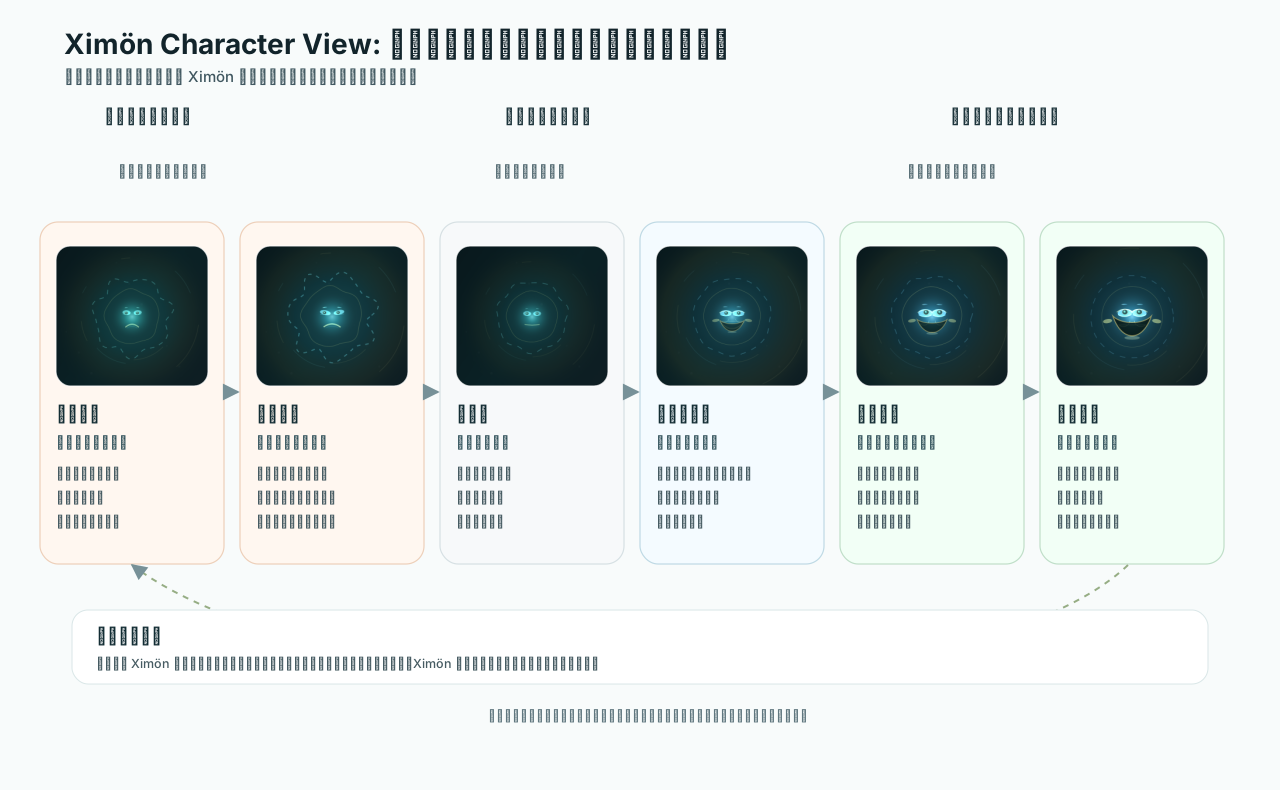
Canonical Ximön Character View
This single integrated map is not a full future simulation. It combines five fixed short scenes into one readable direction, then shows the underlying values as compact bars.
The small Ximön in this panel is only a pure display-only Ximön for this map. It is separate from the central character, and it does not change sound, Life Kernel values, preferences, saved state, or scientific claims.
Evidence View
- Gate34
- same-input repeatability + invariant integrity
- Current source check
- runbook is the authority
- Science ledger
- metric consistency is required
- Package self-check
- external_complete self-audit
- Public hosting
- real origin proof is separate
Research View
- System class
- persistence-centered artificial-life instrument
- Biological boundary
- 有界な測定であり、生物同等性ではありません
- Phase23
- 読み取り専用の統合レイヤー
- Criticality lane
- off
- Shadow target
- preview unavailable
- Like state label
- waiting for Like label
- Liked flow observer
- waiting for trajectory label
- Relaxation proxy
- waiting for research proxy
- Boundary bus
- event surface, not an organism membrane
- Distribution status
- internal green until hosting proof
App save / resume
Installable PWA builds keep one latest local saved state on this device. Resume uses the existing validated restore path; it does not add a new Life Kernel, audio, preference, or automatic-adjustment input.
Like observation log
Exports the bounded current-session labels created by heart and forehead-stroke input. It includes the internal state that produced the sound and the short before/after flow when finalized. It does not create cloud sync, telemetry, a medical record, or unlimited memory.
Open Liked moments in the control dock to see the read-only scatter maps without opening Tools.